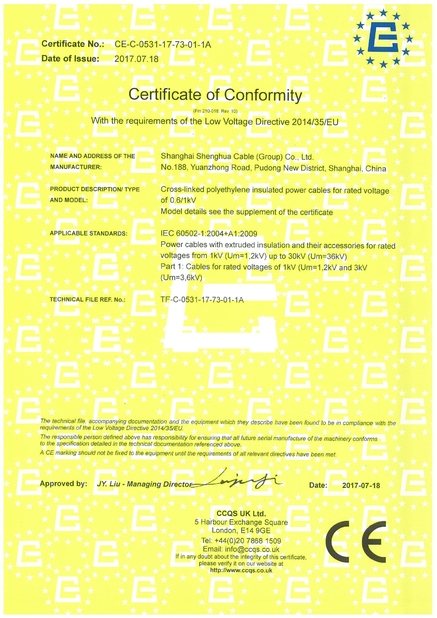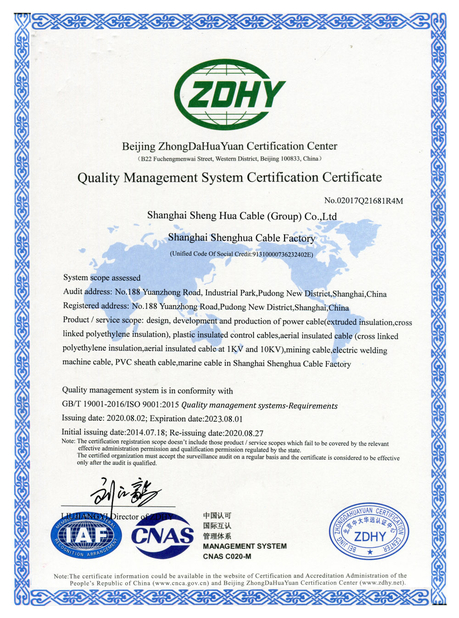
সাংহাই শেনহুয়া কেবেল (গোষ্ঠী) কোং লিমিটেড।
Choosing a cable by installation environment is the step that most often goes wrong between the design office and the purchase order. The same 4x35 mm2 conductor may be perfectly adequate in a ventilated cable tray, marginal in a buried duct and non-compliant on an overhead span, because each environment changes the thermal conditions, the mechanical loads and the moisture exposure. This guide compares the five common installation environments, explains the derating and protection rules that apply to each, and provides a decision table that a buyer can use before issuing an enquiry. It ends with six direct answers on burial depth, duct fill, tray spacing and mixed routes.

Every installation method can be described by three variables: how the heat leaves the cable, what mechanical loads act on it, and how much water or chemical exposure it sees. That description is what determines the construction.
| Environment | Thermal performance | Mechanical need | Moisture and UV |
|---|---|---|---|
| Direct burial | Depends on soil, stable | Armour or heavy sheath | Continuous water, no UV |
| Duct or conduit | Poor, fill dependent | Pulling strength | Possible standing water |
| Cable tray | Good, grouping matters | Physical support only | None unless outdoor |
| Aerial overhead | Wind dependent | Messenger and clamps | Full UV and rain |
| Free air indoor | Good | Support and routing | None, ambient may be high |
The important point is that the environment defines the construction, and the construction then defines the current rating. Choosing the cable first and the route afterwards, which happens frequently on fast-track projects, is how overloaded buried cables end up in service.
Failures caused by environment mismatches are rarely dramatic at the start. They appear as warm cables, tripping breakers, or a fault during a wet season, and the root cause usually traces back to a cable selected on a catalogue rating that assumed a different installation method.
1. Thermal derating differences. A cable rated 110 A in free air may be rated only 85 A when buried in a duct, because the heat path is longer and the surrounding soil or air in the duct is warmer. Selecting a cable on the free air rating for a ducted route is one of the most common design errors, and it produces a cable that runs at 100 degrees Celsius in a 90 degree XLPE design.
2. Mechanical damage in buried routes. An unarmoured cable direct buried in stony ground will be damaged during backfill or by later excavation. The damage may not be immediately visible, but a nick in the sheath becomes a water path and a water path becomes a fault two winters later. Armour also protects against rodent attack, which is a real risk in agricultural and tropical environments.
3. Water in ducts. Ducts collect water and never dry out. A cable in a flooded duct operates in a permanently wet environment, so the specification must include water blocking and a sheath that resists hydrolysis. A cable designed for dry indoor use will lose insulation resistance over years and eventually fail.
4. Fire propagation on trays. Bundled cables on a vertical tray behave as a chimney. A single cable flame test does not predict bunched behaviour, which is why tray routes in risers require a bunched flame category and often an LSZH construction. This is an environment requirement, not a cable preference.
5. Aerial mechanical and UV loads. An aerial cable must resist wind induced vibration, ice load, UV degradation and the mechanical handling of stringing. A standard armoured buried cable strung on poles will fail at the clamps and crack in the sun within a few years, even though its electrical rating is correct.
Use a route walk, not a desk study. Walk the route and record, for each section, the installation method, the ambient or soil conditions, the presence of heat sources, the likelihood of flooding and the access for maintenance. Most routes are mixed: a buried section from the transformer, a duct under a road, a tray in the switch room and a short aerial span to a remote building. In a mixed route the cable must satisfy the most demanding section, and the current rating must be calculated for the worst thermal case rather than the average.
For direct burial, lay at the specified depth on sand or selected fill, install warning tape, and use armour with a PE or HDPE oversheath. For ducts, limit the fill ratio to the figure in the local code, usually around 40 percent of the duct cross section for power cables, and use sealed ends at manholes to keep water and debris out. For trays, maintain the specified spacing, avoid mixing power and communication cables without a barrier, and derate for grouping. For aerial routes, use a purpose-designed construction with a messenger, respect the sag limit, and use clamps with elastomer inserts. For indoor free air, verify the real ambient at the highest point of the route, since hot air accumulates at the top of a riser.
Document the result. A cable schedule should show, for each circuit, the route description, the installation method, the ambient used, the derating factors applied and the resulting current rating. That schedule is the single most useful document at handover, because it tells the next engineer why the cable was chosen and where the margins are thin. It also makes future modification safe, which is rarely considered at design stage.
Finally, protect the transitions. A route that changes from buried to aerial needs a sealed transition, a strain relief at the pole and a drip loop. A route that changes from tray to duct needs a sealed entry and, at the low end, a drain. Transitions are where water enters and where mechanical loads concentrate, so they deserve a detail drawing rather than a verbal instruction to the installation crew.
| Route section | Recommended construction | Critical control |
|---|---|---|
| Buried soil | Armoured XLPE, PE sheath | Depth, bedding, warning tape |
| Road crossing duct | Armoured or heavy sheath | Duct fill, sealed ends |
| Indoor tray | XLPE, LSZH where required | Grouping derating, spacing |
| Riser | LSZH, bunched flame class | Support spacing, fire barrier |
| Overhead span | ABC or UV resistant with messenger | Sag, clamp type, drip loop |
| Transition | Sealed entry, strain relief | Drip loop and drainage |
Product examples include the SWA armoured underground power cable 4x185mm2 XLPE for buried feeders, the direct burial 4 core XLPE SWA cable for general distribution, and the IP68 waterproof PVC cable 4x25mm2 for direct burial in wet ground. Duct and protected routes can use the NYY 4x16mm2 cable for underground duct installation, while exposed outdoor runs take the UV resistant 4x35mm2 PVC cable for aerial overhead use. Where a route combines burial and exposure, the NYY 4x70mm2 anti UV cable for direct burial and sunlight exposure covers both, and larger overhead feeders use the UV resistant aerial 3x185mm2 aluminium XLPE cable.
Real projects are rarely a single environment. A typical industrial feeder leaves a transformer in a buried duct, crosses a road inside a sleeve, rises on a tray in a switch room and finishes with a short exposed run to a remote skid. Each section has a different thermal path, and the temptation is to rate the cable for the section with the best conditions. The correct method is the opposite: identify the section that gives the lowest permissible current, adopt that value for the whole circuit, and then check that the cable construction satisfies every section mechanically and environmentally. Often this results in a cable that is armoured for the buried portion and UV stabilised for the exposed portion, with the current rating set by the ducted section. Choosing that combination deliberately at the enquiry stage is far cheaper than discovering at commissioning that the ratings do not stack up.
The cable schedule produced at design stage becomes the most valuable handover document if it is maintained. It should record, for each circuit, the route description in words, the installation method for each section, the design ambient or soil temperature, the derating factors applied, the calculated current rating and the actual cable designation delivered. Add the as-built route drawing with joint positions and the commissioning test results, and the document becomes a maintenance tool rather than a filing requirement. When a future extension needs to add load to an existing feeder, that record answers the question in minutes instead of requiring a site survey and a fresh calculation. Projects that maintain this document rarely suffer the second failure that follows a badly repaired first one, because the repair crew knows exactly what is installed and where the margins are thin.
A simple discipline ties all of this together. Before the enquiry is released, draw a one page route diagram with each environment marked, write the ambient and soil assumptions next to each section, and note the construction required. Attach it to the purchase enquiry. The factory then quotes against a defined requirement instead of an assumption, the comparison between suppliers becomes meaningful, and the delivered drum can be checked against a document that everyone has already agreed. Most installation related claims disappear at that point, because there is nothing left to interpret.
Depths vary by country and voltage class, commonly 0.6 to 0.8 m for low voltage in open ground and deeper under roads. Always follow the local code and add mechanical protection where required.
A common rule is about 40 percent of the duct cross section for power cables, which allows pulling without damage and limits thermal bunching. Local codes may be stricter.
Only if it is designed for both: armoured for burial and UV stabilised for exposure. Otherwise specify each section separately, or use a construction rated for mixed duty.
Yes. Multiple loaded cables in a tray or on a perforated tray reduce the current rating, and the factor depends on the number of cables and whether they are touching.
Because soil thermal resistivity rises as it dries. A cable sized on wet soil assumptions can exceed its rating in a dry summer, so a conservative soil factor is prudent.
Using a free air current rating for a ducted or grouped installation, followed by damaging the sheath during backfill or pulling over a sharp edge.
The installation environment is not a detail to be settled after the cable is ordered; it is the input that determines the construction and the current rating. Walk the route, classify each section, select the construction for the worst case, derate correctly and protect the transitions. Do that and the cable will run cool and last its design life. Shanghai Shenghua Cable Group supplies armoured, duct rated, UV resistant and aerial cable from 0.6/1 kV to 33 kV, with current rating tables for each installation method. Send your route drawings and ambient data through our contact page and our engineers will produce a cable schedule matched to your installation method.